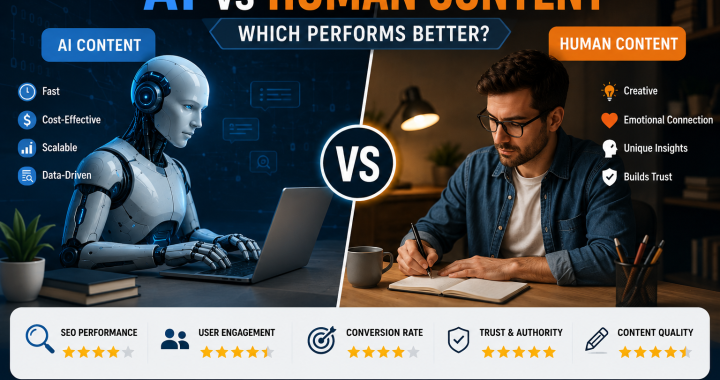
Content marketing is one of the most important parts of digital marketing. Today, businesses use both artificial intelligence (AI) and human writers to create content. AI tools like ChatGPT, Gemini, and Claude can generate articles, blogs, and social media posts in minutes. On the other hand, human writers bring creativity, emotions, and real-life experience to their content.
The big question is AI vs. Human Content—Which performs better?
In this blog, we will compare AI-generated content and human-written content to help you understand which option is best for your business.
What is AI Content?
AI content is text created by artificial intelligence tools. These tools use machine learning and natural language processing to generate content based on user instructions.
Examples of AI content include:
- Blog posts
- Product descriptions
- Social media captions
- Email marketing content
- Website content
AI tools can create content quickly and help businesses save time.
What is Human Content?
Human content is written by professional writers, marketers, or content creators. Human writers use their knowledge, experience, emotions, and creativity to produce content that connects with readers.
Human-written content often includes the following:
- Personal experiences
- Emotional storytelling
- Original ideas
- Industry expertise
- Creative insights
AI Content vs Human Content: Key Differences
| Factor | AI Content | Human Content |
|---|---|---|
| Speed | Very Fast | Slower |
| Cost | Affordable | More Expensive |
| Creativity | Limited | High |
| Emotional Connection | Low | Strong |
| Accuracy | Needs Fact Checking | Usually Better |
| SEO Optimization | Good | Excellent with Strategy |
| User Engagement | Moderate | High |
Benefits of AI Content
1. Faster Content Creation
AI can create articles within minutes. This helps businesses publish content regularly and maintain an active online presence.
2. Cost-Effective
Hiring professional writers can be expensive. AI tools provide a budget-friendly solution for creating large amounts of content.
3. SEO Assistance
Many AI tools can suggest keywords, headings, and content structures that support SEO efforts.
4. Content Scalability
Businesses can generate multiple blog posts, social media updates, and product descriptions quickly.
Benefits of Human Content
1. Better Creativity
Humans can create unique ideas and engaging stories that AI often cannot replicate.
2. Strong Emotional Connection
Readers connect with content that feels personal and authentic. Human writers understand emotions and audience needs.
3. Industry Expertise
Experienced writers can provide valuable insights and real-world examples that increase credibility.
4. Higher Trust
People often trust content that reflects genuine experience and expertise.
Which Performs Better for SEO?
Google focuses on providing helpful, accurate, and valuable content to users. While AI-generated content can rank in search results, quality matters more than who creates the content.
For the best SEO results:

- Use AI for research and content outlines.
- Add human expertise and editing.
- Include real examples and insights.
- Optimize for user intent.
- Ensure content is accurate and useful.
A combination of AI and human input often produces the best SEO performance.
Which Performs Better for User Engagement?
Human-written content generally performs better when it comes to engagement.
Why?
Because humans can:
- Tell compelling stories
- Understand emotions
- Build trust
- Create memorable experiences
AI content may provide information quickly, but it can sometimes feel robotic or repetitive.
Which Performs Better for Conversions?
Conversions happen when visitors take action, such as the following:
- Filling out a contact form
- Making a purchase
- Signing up for a newsletter
Human content usually generates better conversions because it builds trust and addresses customer concerns more effectively.
However, AI can assist in creating high-converting content when reviewed and improved by human experts.
The Best Strategy: AI + Human Collaboration
Instead of choosing AI or humans, businesses should use both.
Use AI for:
- Keyword research
- Content ideas
- Blog outlines
- Meta descriptions
- Draft creation
Use humans for:
- Editing
- Fact-checking
- Storytelling
- Brand voice
- Final optimization
This combination saves time while maintaining quality and authenticity.
Future of Content Marketing in 2026
AI technology continues to improve every year. However, human creativity, emotions, and expertise remain valuable.
The future of content marketing is not AI replacing humans. Instead, it is AI helping humans create better content faster.
Businesses that combine AI efficiency with human creativity will have the strongest content marketing strategy.
Conclusion
When comparing AI vs. human content, both have unique advantages.
AI offers speed, affordability, and scalability, while human writers provide creativity, trust, and emotional connection.
For the best SEO performance, user engagement, and conversions, businesses should combine AI tools with human expertise. This approach creates high-quality content that satisfies both search engines and readers.
If you want long-term success in digital marketing, remember one simple rule:
AI can create content, but humans create meaningful connections.